.png)
Agentic AI refers to autonomous artificial intelligence systems capable of planning, executing multi-step tasks, and making decisions based on human requests. Unlike traditional automation or basic AI tools that require constant guidance, agentic AI systems can independently navigate complex workflows, connect directly to data source systems, adapt to changing conditions, and complete sophisticated financial tasks from start to finish.
A human remains in the loop to oversee the process, but the majority of the legwork is completed by the AI agents. Think of it as having a team of analysts working on your behalf.
Their work is a great starting point and sometimes nearly complete, but you wouldn’t pass along a board report package to your board members without first looking it over and revising accordingly.
In financial planning and analysis (FP&A) and accounting contexts, these AI agents function as intelligent digital assistants that can analyze financial data, generate insights, produce reports, and even recommend actions, while learning from patterns and improving over time.
It’s easy to conflate generative AI with agentic AI, so let’s contrast the two tools. Generative AI is useful to produce content, and insights based on a very specific subset stipulated in a prompt. Its output is generic in nature, like a jack-of-all trades (master of none), with surface level reposes based on prompts.
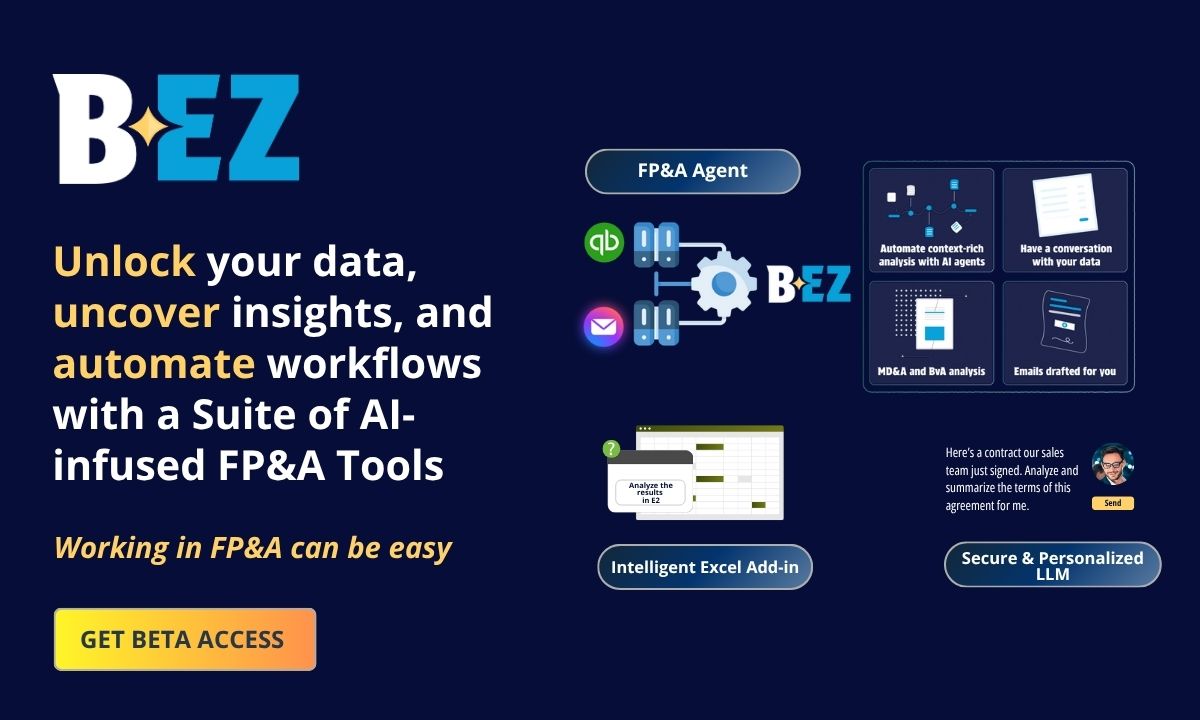
Agentic AI is a different gear entirely. Instead of producing content about your numbers, it actively works through them. It connects to source systems, runs multi-step analyses, investigates variances, builds departmental P&Ls, flags anomalies, drafts MD&A-style insights, and closes the loop without someone babysitting each step.
Think of agentic AI is the analyst that acts with purpose, it applies context and helps you craft the narrative behind the numbers to facilitate informed decision making.
For FP&A teams stretched thin, that difference is everything. Some of the specific use cases of Agentic AI in FP&A include:
The finance function faces mounting pressure: faster close cycles, increased regulatory scrutiny, demand for real-time insights, and persistent talent shortages. Traditional automation handles repetitive data entry, but finance teams still spend 60-70% of their time on data preparation and routine analysis rather than strategic work.
Agentic AI addresses this gap by automating the analytical thinking required for complex financial tasks, not just the data movement.
Early adopters can save hours per week on routine analyses, enabling faster month-end closes and freeing senior staff for higher-value advisory work.
CFOs rank "advanced analytics and AI" as their top technology priority – Gartner CFO Survey 2025
Monthly P&L reviews require analysts to examine dozens of departmental statements, identify variances, research causes, and compile findings, which can easily consume 20-40 hours per month.
With agentic AI for FP&A, ingests P&L data across all departments, identifies material variances against budget and prior periods, investigates root causes by querying transactional systems, and generates preliminary variance analyses with supporting documentation.
Specific Capabilities:
Understanding expense trends requires analyzing thousands of transactions across multiple categories, vendors, departments, and time periods. Manual analysis is time-intensive and often overlooks subtle patterns.
AI agents continuously monitor expense data at transaction level, automatically categorize and classify spending, identify unusual patterns or outliers, benchmark against historical norms and industry standards, and surface opportunities for cost optimization.
Specific Capabilities:
Financial metrics alone don't tell the complete story. Understanding whether performance is good or bad requires business context: market conditions, seasonality, strategic initiatives, competitive dynamics, and operational constraints.
AI agents integrate financial data with operational metrics, market intelligence, and qualitative information to provide holistic performance assessments. They understand that a 10% revenue decline might be positive performance if the market contracted 20% overall due to macroeconomic influences.
Specific Capabilities:
Effective receivables management requires monitoring hundreds or thousands of customer accounts, prioritizing collection efforts, understanding payment patterns, and maintaining customer relationships, all while minimizing DSO.
AI agents continuously analyze ARaging, predict payment likelihood, prioritize collection activities, draft customer communications, and recommend escalation strategies based on account history and risk factors.
Specific Capabilities:
Preparing Management Discussion and Analysis (MD&A), also referred to as management commentary, and board presentations requires synthesizing financial results, operational metrics, market conditions, and strategic initiatives into coherent narratives.
AI agents analyze financial results, research relevant context, identify key themes and drivers, generate draft commentary in appropriate tone and format, and ensure consistency with prior period narratives and regulatory requirements.
Specific Capabilities:

Traditional forecasting relies on spreadsheets with embedded assumptions that are difficult to document, test,and update. Understanding forecast sensitivity and creating multiple scenarios where you rely on statistical analysis is labor-intensive.
AI agents build dynamic forecast models that explicitly track assumptions, automatically update forecasts as actuals come in, generate multiple scenarios, test sensitivity to key drivers, andexplain forecast variances in business terms.
Specific Capabilities:
Detailed Revenue Forecasting
High-performance finance functions treat forecasting like a scientific experiment. They begin by making calculated assumptions. Formulating assumptions for your forecast is the most critical influencer of your outcomes.
If you assume a driver of your COGS will increase by 10% or more, your net income is going to be dramatically reduced, which may cause executive teams and boards to consider decreasing operating expenses and reducing the workforce.
Advanced Forecasting approaches consider the following:
Financial data flows through multiple systems, requires transformations, and manual intervention, creating numerous opportunities for errors. Meanwhile, traditional data quality checks are rule-based and miss nuanced issues.
AI agents continuously monitor data across systems, identify anomalies and inconsistencies, validate completeness and accuracy, flag potential errors before they impact reporting, and learn from corrections to improve detection over time.
Specific Capabilities:
Understanding customer behavior requires segmenting customers by various dimensions (acquisition date, product mix, industry, size, geography), tracking metrics for each cohort, and identifying patterns is extremely useful, but equally cumbersome to produce.
AI agents can automatically segment customers into meaningful cohorts, track retention, expansion, and churn patterns, calculate lifetime value and payback periods, identify characteristics of high-value vs. at-risk customers, and generate actionable insights for sales and customer success teams.
Agentic AI represents a fundamental shift in how finance functions operate, not by replacing professionals, but by eliminating the routine analytical work that prevents them from delivering strategic value. The eight use cases outlined here demonstrate proven applications delivering measurable ROI today.
The organizations that will thrive are those that view AI as a tool for augmentation rather than replacement, that maintain appropriate skepticism while embracing innovation, and that focus on developing the uniquely human skills, like judgment, relationship-building, and strategic thinking, which AI cannot replicate.
The future of finance is AI and humans working together, each contributing what they do best. AI for speed, and humans for sense.


.png)